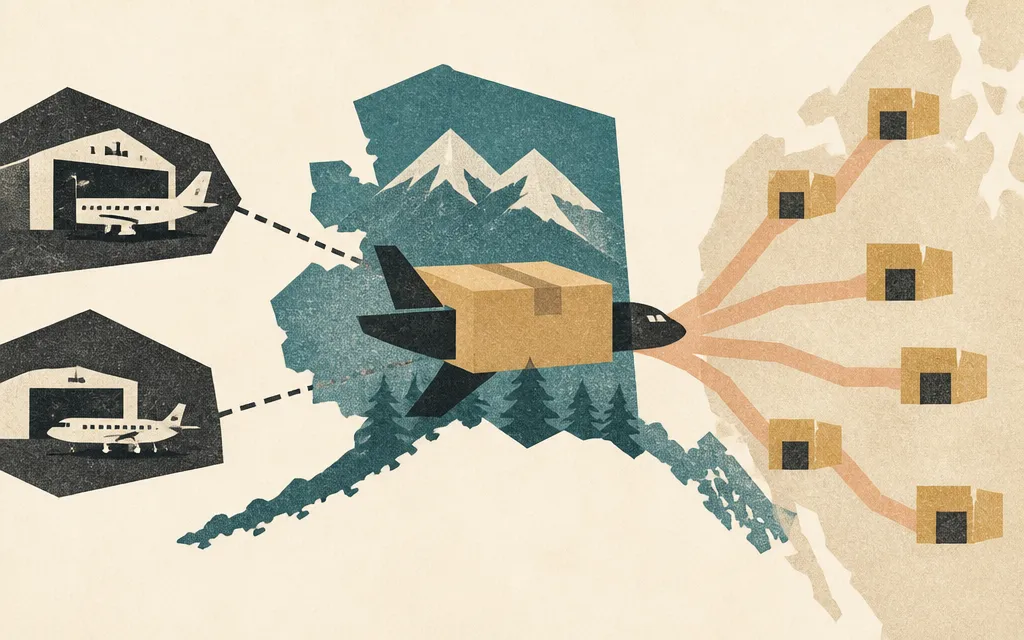
Amazon.com (AMZN) occupies the most interesting square on Alaska Air Group’s (ALK) relationship map. It is a customer for the cargo operation, and a counterparty whose agreement also appears in Alaska’s freighter-related expenses. Airlines usually prefer their charts to have fewer plot twists.
The customer side is explicit. Alaska says its cargo revenue grew after adding the final four contracted Airbus freighters under the agreement with Amazon.
"Cargo and other revenue On a pro forma basis, Cargo and other revenue increased $89 million, or 19%, primarily driven by increased revenue under the ATSA with Amazon following the addition of the four remaining contracted A330-300F aircraft to our cargo fleet…"
Alaska Air Group / Form 10-K / Feb. 12, 2026
In plain English, the disclosed cargo relationship with Amazon was tied to 19% growth in cargo and other revenue on a pro forma basis. The aircraft arrived, and the Amazon-linked operation became larger in the filing.
But Amazon also appears on the cost side of Alaska’s reporting. The company says it adjusts its figures for expenses directly tied to freighter operations, including those incurred under the same ATSA.
"We adjust for expenses related directly to our freighter aircraft operations, including those costs incurred under the ATSA with Amazon, to allow for better comparability to other carriers that do not operate freighter aircraft."
Alaska Air Group / Form 10-K / Feb. 12, 2026
That makes Amazon a two-sided disclosed relationship: cargo revenue on one side, freighter operating expenses on the other. The filing does not turn this into a broader conclusion. It simply names the counterparty in both places.
The aircraft supply chain is separately tied to The Boeing Company (BA). Alaska says Boeing communicated that some aircraft deliveries would arrive later than the contracted timing.
"Boeing has communicated that certain B737 and B787 aircraft are expected to be delivered later than the contracted delivery timing."
Alaska Air Group / Form 10-K / Nov. 6, 2025
The company’s disclosed aircraft relationship therefore has a timing wrinkle, stated by Boeing and reported by Alaska. No additional cause or outcome is provided in the supplied filing language.
On regional flying, Alaska names SkyWest (SKYW) as a third-party carrier paid under a capacity purchase agreement. The expense increased as SkyWest operated more departures and block hours.
"Third-party regional carrier expense On a pro forma basis, third-party regional carrier expense, which represents payments made to SkyWest under the CPA with Alaska, increased $29 million, or 12%, driven by incremental departures and block hours operated by…"
Alaska Air Group / Form 10-K / Feb. 12, 2026
That is a disclosed operating partnership, with payments linked to the amount of flying performed. It is a different arrangement from Amazon’s cargo agreement, but both relationships show up in Alaska’s operating machinery.
The Hawaiian assets also appear in Alaska’s financing structure. Alaska discloses an $850 million revolving credit facility secured by aircraft, slots, gates, routes, and other eligible assets associated with Alaska and Hawaiian. The filing separately says it paid $659 million in 2024 to acquire Hawaiian Airlines, a relationship tagged here to Hawaiian Electric Industries (HE).
"Bank lines of credit Alaska has a revolving credit facility for $ 850 million, expiring in September 2029, which is secured by a combination of Alaska and Hawaiian aircraft, slots, gates, routes, and other eligible assets."
Alaska Air Group / Form 10-K / Feb. 12, 2026
"In 2024, we paid $659 million to acquire Hawaiian Airlines, net of Hawaiian's cash balances."
Alaska Air Group / Form 10-K / Feb. 12, 2026
The filing thus connects the Hawaiian assets to both the acquisition disclosure and the collateral package. Separately, Alaska names Delta Air Lines (DAL) as its largest competitor, with Southwest Airlines (LUV) and United Airlines (UAL) also significant competitors in Hawaii and on the West Coast. It adds that capacity overlap is particularly significant in those markets.
"Our largest competitor is Delta Air Lines Inc. (Delta)."
Alaska Air Group / Form 10-K / Feb. 12, 2026
"In addition to Delta, Southwest Airlines and United Airlines are significant competitors in the state of Hawai'i and on the West Coast."
Alaska Air Group / Form 10-K / Feb. 12, 2026
"We have significant capacity overlap with competitors, particularly in our key West Coast and Hawaiian markets."
Alaska Air Group / Form 10-K / Feb. 12, 2026
The resulting map is concentrated by design: Amazon touches both cargo revenue and freighter costs; Boeing touches aircraft timing; SkyWest touches regional capacity; Hawaiian touches ownership and collateral; and the major airline rivals cluster around the same West Coast and Hawaiian routes.
These are relationships disclosed in SEC filings, mapped by jodie’s analytics. This is not investment advice.