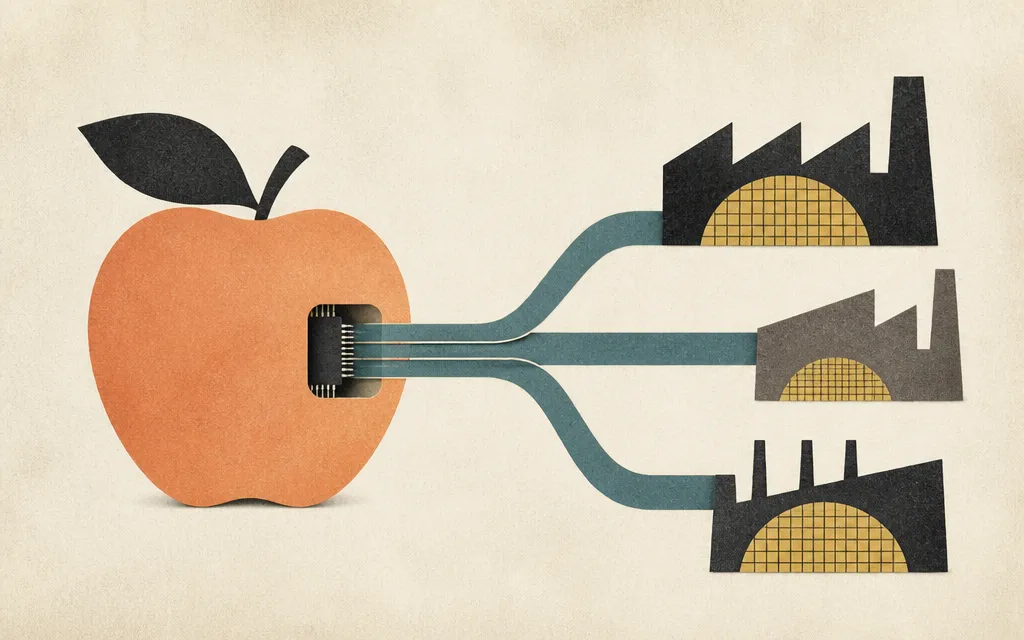
Cirrus Logic (CRUS) is not merely selling into Apple (AAPL). Its disclosed web runs from Apple’s purchasing decisions into the factories that make Cirrus chips. One customer accounts for nearly the entire sales base, while two foundries primarily supply the wafers and one of them is now part of a manufacturing program involving that same customer.
The customer concentration is unusually clear in Cirrus’s filing. Apple buys through multiple contract manufacturers, but the end customer is still Apple.
"We had one end customer, Apple Inc., that purchased through multiple contract manufacturers and represented approximately 86 percent and 88 percent of the Company’s total net sales for the first quarter of fiscal years 2026 and 2025, respectively."
Cirrus Logic / SEC filing / August 5, 2025
In plain English, contract manufacturers sit in the middle of the transaction, but Apple sits at the other end of 86% of Cirrus’s sales. The filing’s customer map has one very large dot.
On the supply side, Cirrus names two primary wafer sources rather than a single foundry.
"We use a variety of foundries in the production of wafers, primarily supplied by GLOBALFOUNDRIES Inc., (\"GlobalFoundries\") and Taiwan Semiconductor Manufacturing Company, Limited (\"TSMC\")."
Cirrus Logic / SEC filing / May 21, 2026
That puts GlobalFoundries (GFS) and Taiwan Semiconductor Manufacturing Company (TSM) at the front of the disclosed production chain. Cirrus says it uses a variety of foundries, but identifies those two as the primary suppliers.
The more interesting link is that GlobalFoundries also appears as a partner in the Apple relationship. Cirrus says it joined a program tied to its largest customer and is working with both that customer and GlobalFoundries on new processes.
"We recently joined our largest customer’s American Manufacturing Program and are working with both our customer and GlobalFoundries to develop new process technologies for our products, including our efforts to manufacture for the first time at the Malta, New…"
Cirrus Logic / SEC filing / May 21, 2026
The disclosed triangle is therefore customer, foundry, and chip designer: Apple is the largest customer, GlobalFoundries is a primary wafer supplier, and both are named in the process-development work. The filing does not need a flowchart. It supplied one.
Cirrus also names Amkor Technology (AMKR) among its primary assembly and test houses, extending the chain beyond wafer fabrication.
"The Company’s primary assembly and test houses include Advanced Semiconductor Engineering, Inc., Amkor Technology, Inc., STATS ChipPAC Pte."
Cirrus Logic / SEC filing / May 21, 2026
After fabrication, Amkor is one of the disclosed companies involved in assembly and testing. Cirrus does not identify it as the only such house.
The competitive set is broader than the customer list. Cirrus names Analog Devices (ADI), QUALCOMM (QCOM), Skyworks Solutions (SWKS), Synaptics (SYNA), and Texas Instruments (TXN), alongside several other semiconductor companies.
"Our primary competitors include, but are not limited to, AKM Semiconductor Inc., Analog Devices Inc., QUALCOMM Incorporated, Realtek Semiconductor Corporation, Renesas Electronics Corporation, Shanghai Awinic Technology Co., Ltd., Shenzhen Goodix Technology…"
Cirrus Logic / SEC filing / May 21, 2026
So the map is lopsided in one place and crowded in another: Apple dominates the disclosed customer exposure, GlobalFoundries and TSMC sit at the primary wafer-supply layer, Amkor appears in assembly and test, and Cirrus names a long list of rivals. The defining relationship is not mysterious. It is Apple, with a semiconductor supply chain attached.
These are relationships disclosed in SEC filings, mapped by jodie’s analytics. This is not investment advice.