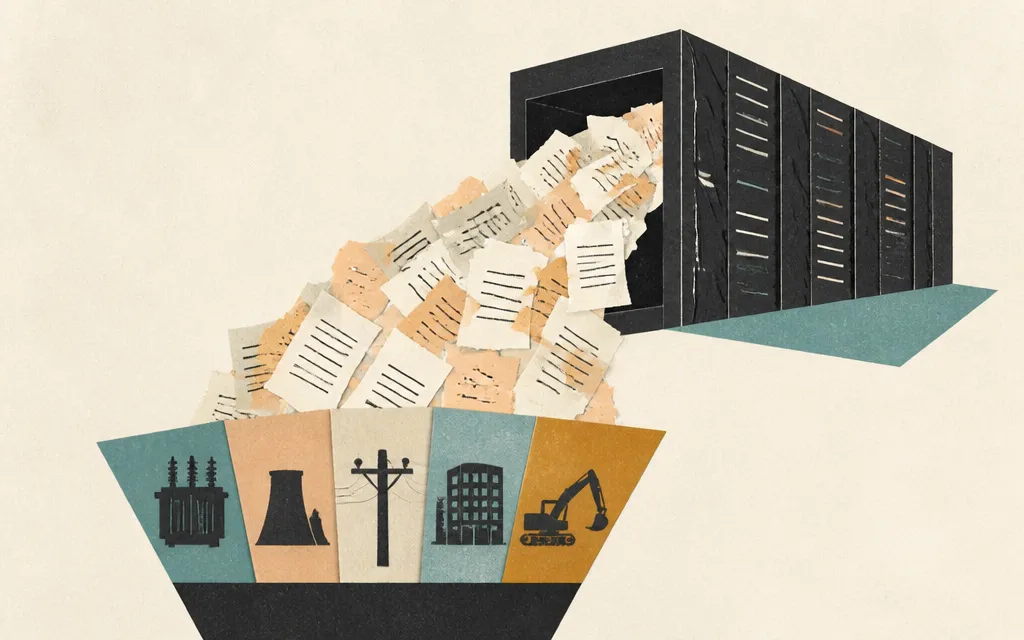
Data-center and AI demand is turning up in more corners of corporate America, though the move is a tick, not a takeover.
In the latest 21-day filing window, 70 distinct companies flagged the topic. That was 13.5% of filers, compared with 11.1% in the same-length window one quarter earlier. Put differently, the share was about 1.21 times higher. “More common” is the accurate headline. “Suddenly everywhere” is not.
The companies doing the talking are not confined to chip designers or cloud operators. Cummins tied the theme to North American power-generation equipment sales:
"Distribution segment sales for the six months ended June 30, 2026, increased $494 million versus the comparable period in 2025, mainly due to increased demand in power generation equipment in North America, especially in data center and commercial applications."
Cummins Inc. / 10-Q / 2026-08-04
That is the physical version of the AI buildout: equipment that supplies power to the facilities, rather than software that runs inside them.
Moog, another industrial company, found the demand in its backlog, specifically in the machinery that helps keep those facilities cool:
"Industrial's twelve-month backlog increased primarily due to higher demand for data center cooling pumps."
Moog Inc. / 10-Q / 2026-07-31
The filing does not need to mention a server chip to make the connection. Cooling appears as its own order stream here.
The same subject also reached a utility filing, where the language was less about orders and more about serving a new load. Alliant Energy described a regulatory approval tied to a customer building a data center:
"In June 2026, the PSCW approved an ICR for a customer who is constructing a data center in WPL’s service territory, subject to certain conditions, including the recognition of demand revenue received prior to WPL’s next retail electric rate review through WPL’s retail electric fuel cost recovery mechanism."
Alliant Energy Corporation / 10-Q / 2026-07-31
Here, data-center demand appears as a customer project and a question of how electricity revenue gets recognized. The jargon is dense, but the underlying disclosure is straightforward: a customer project is part of the utility's current filing landscape.
Eaton offered a broader industrial read, with data centers helping lift sales even as other end-markets were weaker:
"Organic change in backlog 33 % 6 % Organic change in customer orders 41 % 2 % Book-to-bill 1.3 1.1 The increase in organic sales in the second quarter of 2026 was due to strength in data center and machine OEM end-markets, partially offset by weakness in residential and industrial end-markets."
Eaton Corporation, PLC / 10-Q / 2026-07-31
The company placed data centers alongside machine OEMs as a source of strength, while explicitly naming residential and industrial weakness. That makes the filing less like a single-theme victory lap and more like a map of which customers are ordering.
Real estate company Equinix showed the other side of the buildout: expanding data centers also brings bigger operating lines. Its EMEA costs rose alongside expansions, utilities and compensation:
"The increase in our EMEA cost of revenues was primarily due to: $24 million of higher depreciation expense driven by IBX data center expansions; $11 million of higher utilities expense, primarily due to increases in renewable energy costs; and $9 million of higher compensation costs."
Equinix, Inc. / 10-Q / 2026-07-29
That is a useful counterweight to the upbeat demand language. The topic can mean a pump order, a power customer, stronger backlog, or more depreciation and utilities expense, depending on where a company sits in the chain.
Across the filings, the approximate keyword tally leaned positive, with 20 mentions tagged positive and three negative. The cited filings show why: they describe demand, orders or construction activity, while Equinix's disclosure adds the bill attached to expanding capacity. Together, they show a modestly broader conversation, not a single uniform corporate message.
This is a descriptive reading of SEC filings via jodie's analytics, not investment advice.