Amcor got much bigger in twelve months. Sales rose 57% to $23.5 billion, operating income climbed 88% to $1.9 billion, and net income more than doubled to $1.1 billion.
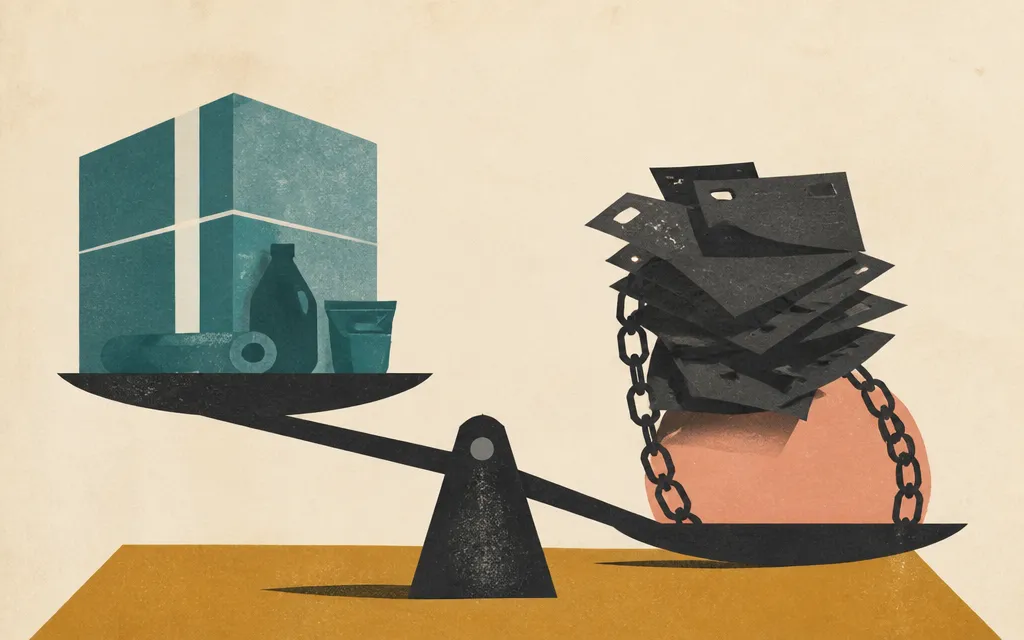
That is the easy read. The harder one is that the larger business came with a larger claim on its earnings. Diluted shares rose 46% to 463.8 million, while interest expense increased 71% to $676 million. The merger added scale, and it also changed the financing picture.
Amcor’s own results put the operating improvement plainly:
"Results of Operations Consolidated Results of Operations ($ in millions, except per share data) 2026 2025 Net sales $ 23,506 $ 15,009 Operating income 1,899 1,009 Operating income as a percentage of net sales 8.1 % 6.7 % Net income attributable to Amcor plc $ 1,106 $ 511 Diluted Earnings Per Share $ 2.38 $ 1.60 Net sales increased by $8,497 million, or 57%, in fiscal year 2026, compared to fiscal year 2025."
10-K 2026-08-14
Margins improved too. Gross margin expanded from 18.9% to 20.0%, and operating margin from 6.7% to 8.1%. The Rigid Packaging segment supplied the loudest part of the growth, with revenue up 116% to $10.7 billion, while Flexibles rose 27% to $12.8 billion.
Management attributed the profit increase to higher gross profit and other income, partly offset by merger-related costs. The expense list includes $726 million more in selling, general and administrative costs, $312 million more in amortization of acquired intangible assets, and $280 million more in interest expense.
The financing line deserves its own receipt:
"Interest expense increased by $280 million, or 71%, in fiscal year 2026, compared to fiscal year 2025, primarily driven by the additional debt issued and assumed in the Merger."
10-K 2026-08-14
That is not a footnote-sized increase. It was roughly a third as large as the $890 million increase in operating income, though the company still produced more net income and higher diluted earnings per share. The share count matters because the earnings pool was divided among many more shares, even with EPS rising to $2.38.
Cash also shows the cost of building the bigger machine. Operating cash flow rose 55% to $2.2 billion, but capital spending rose 59% to $922 million. Cash conversion, measured against net income, fell from 2.72x to 1.94x. Amcor says the cash-flow change came from higher net income adjusted for non-cash items, partly offset by higher working-capital outflows.
The company also said the standalone business was not simply selling more packages at higher volumes. Excluding merger effects, currency, and the pass-through of higher raw-material costs, the remaining sales variation was a $50 million decrease, reflecting unfavorable sales volumes of about 1%, partly offset by favorable price and mix.
That leaves a specific open loop for Amcor’s next report: whether operating cash flow continues to outpace capital spending as the merger’s debt, higher share count, and working-capital effects remain visible.
The comparison shows a bigger business alongside higher financing costs and a larger share count.
Source: Amcor fiscal 2026 Form 10-K, filed August 14, 2026.