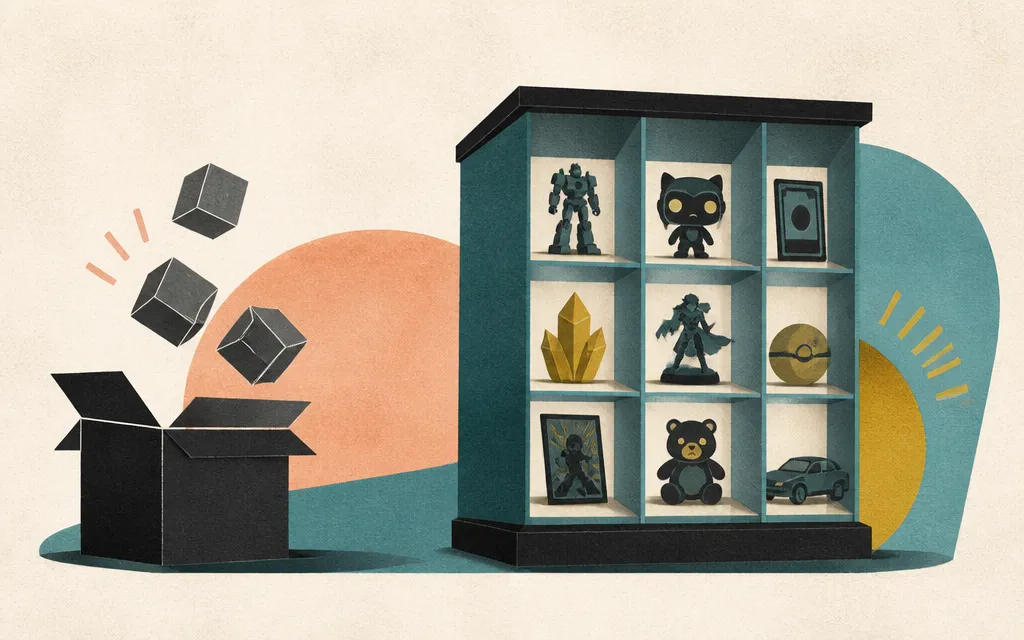
For every $3 of sales GameStop lost over six months, it added about $1 of gross profit. Revenue fell 18.7% to $790.2 million, while gross profit climbed 21.9% to $345.0 million.
That is the cleanest way to read GameStop's latest 10-Q: the business sold materially less, but what it sold carried more margin. Operating income rose 141.3% to $160.2 million, and operating cash flow increased 29.0% to $399.8 million.
The shift was not subtle. Collectibles made up 43.4% of sales in the six months ended August 1, up from 25.8% a year earlier. Video games fell to 33.8% from 49.6%, leaving the company with a much fatter gross margin, 43.7% versus 29.1%.
Management gives the mix change directly:
"The increase in Gross profit and gross margin was primarily driven by a shift in sales mix towards our higher-margin product categories: sales of Collectibles increased to 43.4% of Net sales for the six months ended August 1, 2026, compared to 25.8% in the prior year period, while sales of Video Games decreased to 33.8% of Net sales, compared to 49.6% in the prior year period."
GameStop 10-Q, 2026-09-09
The arithmetic is favorable, but the top-line engine is still smaller. Video game sales declined $295.0 million, or 34.9%, during the six months. GameStop attributes the comparison to the prior-year launch of the Nintendo Switch 2, which lifted hardware, trade-ins, and pre-owned sales then. There was no comparable launch this time.
That leaves a business with better reported margins and less reported revenue. It also leaves a different capital structure: diluted shares rose 8.4% to 592.6 million, while stock compensation increased to $15.8 million from $11.8 million. The filing does not turn those figures into a management explanation, but the share count is part of the profit-per-share math.
Cash is another place where the headline needs a footnote. Cash and equivalents fell to $4.9 billion from $8.7 billion, but the comparison includes $4.2 billion of convertible-note proceeds in the prior-year period. GameStop also invested in eBay common stock during fiscal 2026.
The company describes that use of cash this way:
"Cash used in investing activities during the six months ended August 1, 2026 was primarily driven by the equity investment in eBay, partially offset by proceeds from the sales and maturities of marketable securities."
GameStop 10-Q, 2026-09-09
So the balance-sheet change is not a simple cash-burn story. The latest period produced $399.8 million of operating cash, while cash declined partly because last year's period contained a large financing inflow and this year's included the eBay investment. GameStop ended with $2.1 billion of net cash by the latest annual balance-sheet measure.
The longer record adds some scale. Annual revenue fell from $8.5B in 2018 to $3.6B in 2026, while operating margin moved from 5.1% to 6.4% over that span. The latest six-month figures push the margin improvement further, but through a product mix that is still replacing lost game sales rather than adding to them.
GameStop's next quarterly report will make the current tension easier to measure through one specific comparison: whether collectibles remain near this period's 43.4% sales mix as the prior-year Switch 2 launch rolls out of the comparison.
More margin, fewer sales. Retail arithmetic has found a new favorite shelf.
Source: GameStop 10-Q filed September 9, 2026.