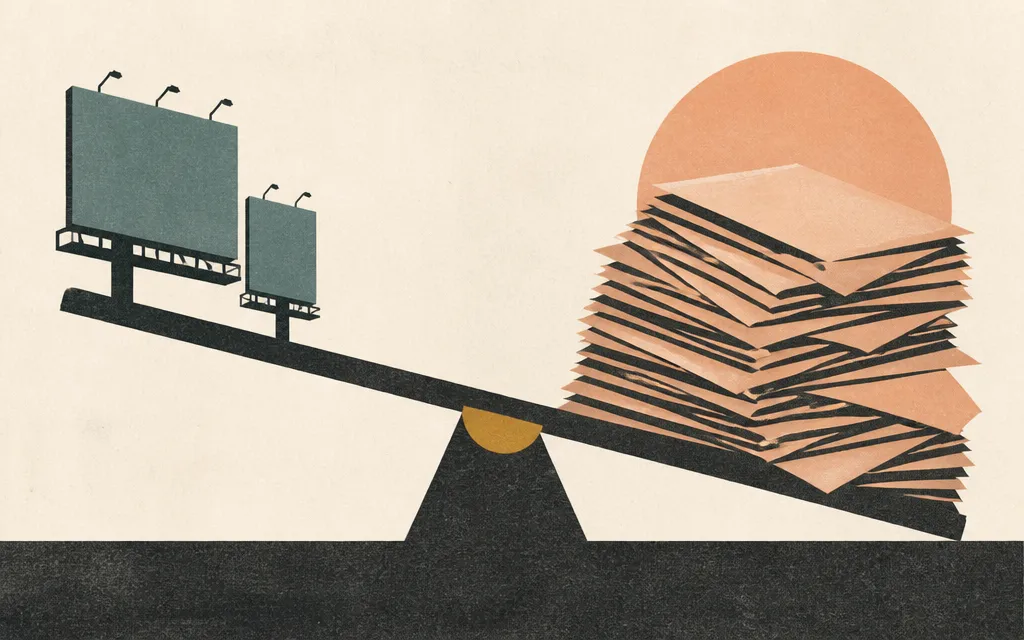
A billboard is getting more expensive to lease at OUTFRONT Media. Billboard property lease expenses rose $6.0 million, or 5%, in the three months ended June 30, even as the company’s revenue climbed to $522.5 million.
That sounds like a pairing seen in a growing advertising business: more revenue alongside more variable rent. The less ordinary part is what happened to profit. Operating income jumped 106.6% to $116.1 million, lifting operating margin from 12.2% to 22.2%.
OUTFRONT says the margin improvement came partly from the mix of the business, not simply from selling more billboard space. Higher Transit revenue and the loss of billboards lowered billboard lease expenses as a percentage of revenue. The company did not quantify how much of the quarter’s margin expansion came from either factor.
Management’s explanation is unusually revealing because the underlying cost line still moved higher:
"Billboard property lease expenses increased $6.0 million, or 5%, in the three months ended June 30, 2026, compared to the same prior-year period, primarily driven by higher variable billboard property lease expenses, partially offset by the impact of lost billboards in the period."
OUTFRONT Media, Form 10-Q, Aug. 6, 2026
OUTFRONT generated much more profit while paying more variable billboard rent. The reported margin improvement therefore carries two different operating signals: stronger revenue in Transit, alongside a smaller billboard base affecting the cost ratio.
The income statement moved faster than the balance sheet. Net income rose from $19.5 million to $77.5 million, while diluted shares increased 5.7% to 177.5 million. Cash barely changed by comparison, rising 9.5% to $31.2 million, and accounts receivable rose 17.6% to $352.3 million, faster than revenue.
That receivables increase is an observation, not an explanation. OUTFRONT does not say why it grew faster than sales. It means the balance-sheet increase was larger in accounts receivable than in cash. The next quarterly report’s comparison of collections, receivables, and operating margin is the disclosure that would put those pieces in the same frame.
Cash generation offered a second counterweight. Capital spending fell 4% in the six months ended June 30, while free-cash-flow margin improved by 8.2 percentage points. Management attributed the spending decline to lower investment in digital displays, office remodels, and billboard upgrades, partly offset by payment timing.
"Capital expenditures decreased $1.6 million, or 4%, in the six months ended June 30, 2026, compared to the same prior-year period, primarily due to decreased spending on digital displays, office remodels and billboard display upgrades, partially offset by the timing of payments."
OUTFRONT Media, Form 10-Q, Aug. 6, 2026
That provides cash-flow context alongside the earnings number, but it also describes lower investment in digital displays and billboard upgrades. The latest annual record supplies some context: revenue was $1.8B in both 2024 and 2025, while operating margin moved from 23.2% to 16.0%. OUTFRONT has seen margins move sharply before without a comparable change in annual sales.
At the latest close, OUTFRONT was valued at 36.9x earnings, with $2.5B of net debt. The current filing leaves a precise question for the company’s next report: are the higher margins holding as receivables convert and investment in billboard upgrades changes?
OUTFRONT’s Aug. 6 10-Q reports higher Transit revenue, lost billboards, faster receivables growth than revenue, and lower capital spending.