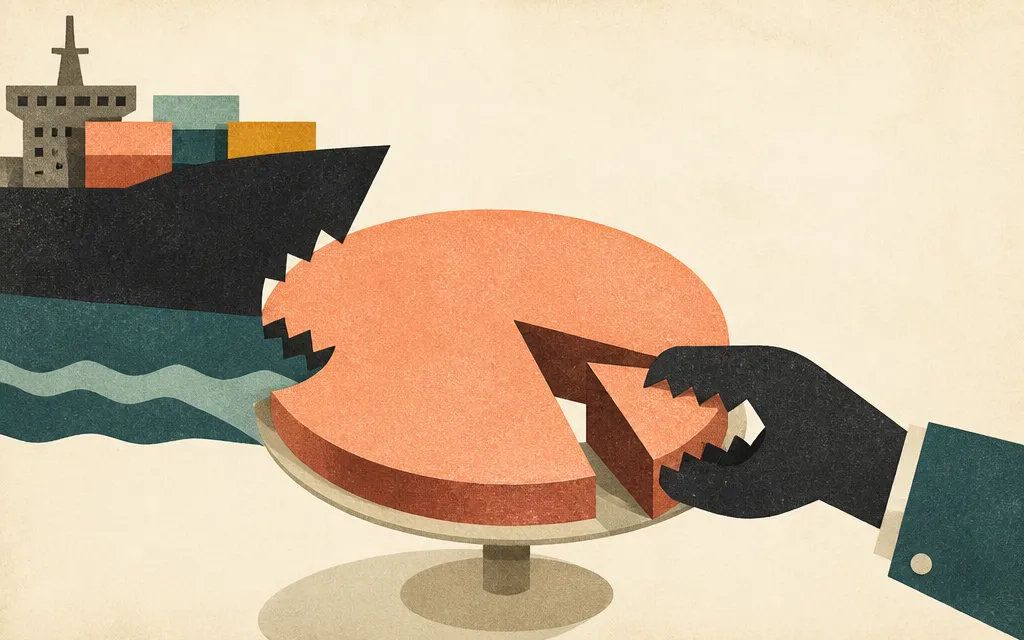
Freight costs rose $28 million at Packaging Corporation of America in the three months ended June 30. The company also added newly acquired Greif operations, but the physical business got bigger faster than the profit pool did.
Revenue rose 14.7% to $2.5 billion from $2.2 billion in the comparable three months. Gross profit grew only 6.1%, and operating income fell 12.7% to $291.2 million. Operating margin dropped to 11.7% from 15.4%.
That is the filing's central tension: PCA added volume and sales through the acquisition, but the costs attached to moving and running that business outran the gross-profit increase. Net income fell 20.5% to $192.1 million, with diluted earnings per share down to 2.15 from 2.67.
Management's operating bridge puts the pressure in fairly ordinary places, which is part of the point. The acquisition and higher sales and production volume added to the result, while freight, product prices and mix, fixed expenses, maintenance outages, depreciation, fiber, labor, and operating costs pulled in the other direction.
"The increase was driven primarily by the impact of newly acquired Greif operations ($36 million) and higher sales and production volume ($31 million), partially offset by higher freight expenses ($28 million), lower containerboard and corrugated products prices and mix ($14 million), higher fixed and other expenses ($8 million), higher maintenance outage expenses ($5 million), higher depreciation expense ($2 million), higher fiber costs ($2 million), and higher labor and operating costs ($1 million)."
[10-[Q](https://jodie.ai/t/Q) 2026-08-07]
The positive contributions were real, but the list also shows how quickly they can be absorbed. Freight alone took nearly as much as the acquisition contribution in this management bridge, before the other costs arrived.
Financing added another layer below operating income. PCA said interest expense increased because it financed the Greif acquisition, while lower cash balances generated less interest income.
"The increase in interest expense, net was primarily due to higher interest expense in 2026 as a result of the Company’s financing for the Greif Acquisition and lower interest income as a result of lower interest rates on lower cash balances."
10-Q 2026-08-07
The balance sheet shows the cash consequence without assigning it a cause the company did not provide: cash at June 30 fell 43.8% year over year to $442.8 million. Inventory rose 10.3% and accounts receivable rose 19.9%, while capital spending increased 16.6% on a comparable basis. PCA's six-month free-cash-flow margin declined 0.6 percentage points.
The current margin also sits inside a broader company pattern. PCA's annual operating margin reached 16.8% in 2022, then fell to 12.3% in 2025. The latest 11.7% reading is not just an acquisition-period curiosity, though the filing attributes several current costs specifically to the newly added operations and financing.
Shares closed at $252.63 on Aug. 6, down 1.3% that day. At 29.2 times earnings, the stock is being discussed against a business that is adding sales, but whose latest three months converted that growth into less operating and net income. The arithmetic is simple; the operating bridge is not.
PCA's next quarterly report will give the cleanest comparison through its reported freight-expense change against the $28 million increase disclosed for these three months.
Source: Packaging Corporation of America's 10-Q filed Aug. 7, 2026, for the three months ended June 30, 2026.