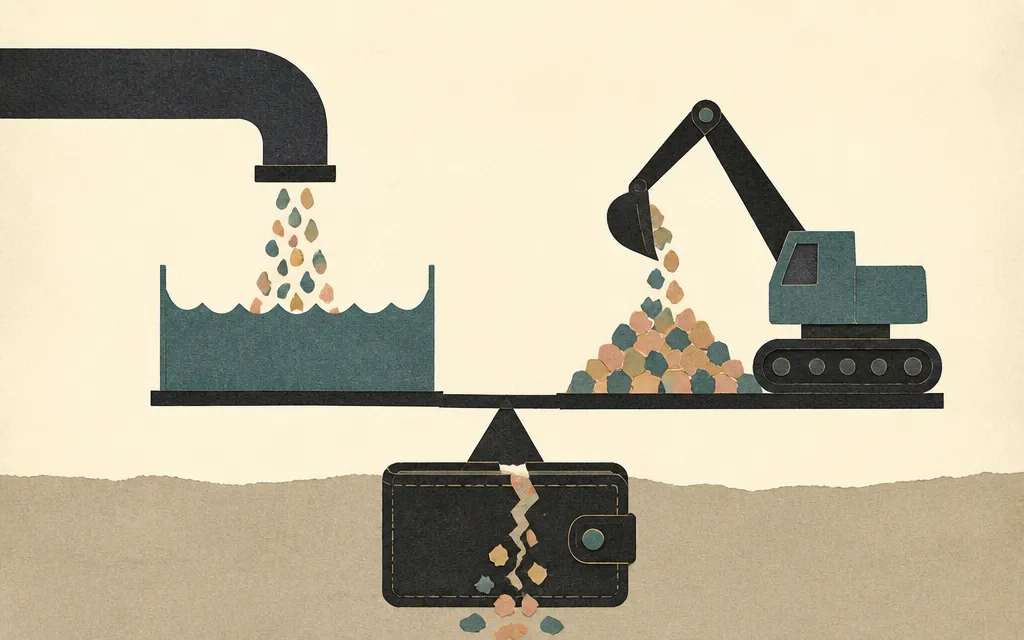
Southwest Gas made more money from operations and spent more cash building the system.
In the three months ended June 30, operating income rose 30.8% to $84.3 million, and net income swung from a $40.2 million loss to $42.1 million of profit. Diluted earnings moved from a 56-cent loss to 58 cents of profit per share. On the surface, this is a rate-regulated utility getting paid more for the work it does.
The sharper detail is where that improvement came from, and where the cash went. Southwest Gas said updated rates and capital investments across California added $19.5 million of incremental operating margin. Customer growth added another $1.4 million. The rate case did a lot of the heavy lifting.
Management described the margin change this way:
"Partially offset by: $25.5 million higher Operating margin primarily driven by updated rates that better align with Southwest Gas’ cost of service and capital investments across California adding approximately $19.5 million of incremental margin, the majority of which was attributable to the revenue recognized in connection with final approval of the All-Party Settlement, before adjustments to cost of capital, associated with the California general rate case, and $1.4 million attributable to customer growth for all territories."
Southwest Gas, Form 10-Q filed Aug. 5, 2026
That is an improvement in the income statement, but it is also unusually specific: much of the lift came from final approval of a California rate settlement, rather than from customer additions alone.
Meanwhile, capital expenditures and property additions rose 60.8% to $320.4 million. Cash fell 23.9% to $270.5 million. Accounts receivable dropped 83.2% to $118.6 million, yet the lower receivable balance did not prevent cash from declining.
The company tied the larger cash use directly to investment:
"The increase was primarily from the increase in cash flows used in continuing operations of $168.2 million driven by the increased outflows for capital expenditures and property additions compared to 2025."
Southwest Gas, Form 10-Q filed Aug. 5, 2026
The balance-sheet arithmetic also includes financing timing. Cash flow used in continuing operations decreased by $418.6 million because Southwest Gas did not repay short-term debt and related borrowings in the current period, unlike in 2025. That helped the period’s cash movement, but it does not change the basic tradeoff disclosed in the report: rate relief improved reported earnings while system investment demanded more cash.
The backdrop is a company with $4.5 billion of net debt and a $6.3 billion market capitalization, based on its latest annual facts. Its latest close was $89.02 on Aug. 4, down 0.9% for the day. Those figures do not resolve the filing’s central question, which is less about whether rates improved the income statement than how the higher investment program will show up in cash generation.
Southwest Gas’s next quarterly report will have to put another period of capex and operating cash beside the rate-related margin contribution. The question left open here is simple: how much of the earnings lift becomes recurring cash after the capital bill is paid?
Southwest Gas disclosed higher rate-related operating margin alongside increased capital-expenditure cash use in its Aug. 5, 2026 Form 10-Q.