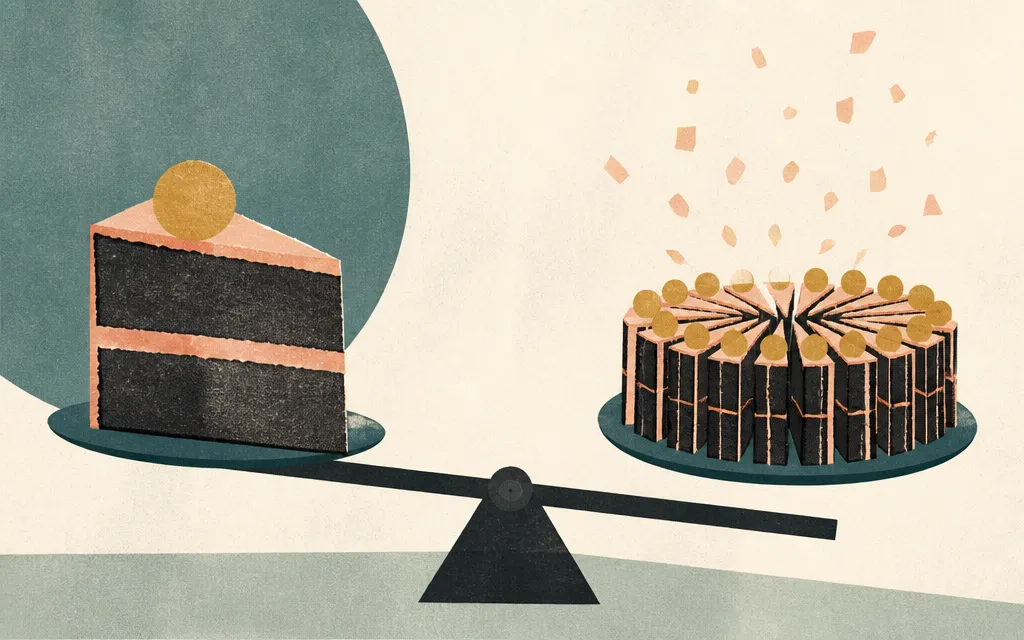
Stifel made more money, but each diluted share got less of it.
In the three months ended March 31, revenue rose 1.9% to $1.7 billion from the comparable period a year earlier. Net income climbed 18.9% to $251.4 million, and net margin widened from 12.9% to 15.1%.
Then the arithmetic turns. Diluted shares jumped 48.5%, from 110.1 million to 163.4 million. That left diluted EPS at $1.48, down from $1.84, even as the company reported more profit.
The filing does not identify a single reason for the share-count increase. It does show that stock compensation is taking up a larger share of revenue, up 3.9 percentage points, while free-cash-flow margin declined 38.4 percentage points. Those are separate disclosures, not a stated causal chain, but they put the earnings increase in a less tidy frame: more income arrived alongside a much larger denominator and weaker cash conversion.
Management says activity improved in parts of the franchise. Equity capital-raising revenue increased 37.3% to $67.3 million, with larger deal sizes and higher volumes cited as the drivers.
"For the three months ended March 31, 2026, equity capital-raising revenues increased 37.3% to $67.3 million from $49.0 million during the comparable period in 2025 driven by higher volumes and larger deal sizes."
Stifel, Form 10-Q, May 4, 2026
That is a concrete sign of stronger deal activity, even with total revenue barely moving. Other pieces ran in the opposite direction: interest revenue fell 5.2% to $451.0 million as rates declined, partly offset by higher interest-earning assets. Stifel also attributed increased client activity to the continued normalization of the yield curve.
Cash adds another layer. Cash fell 9.0% to $2.9 billion from $3.2 billion, despite $1.2 billion provided by financing activities. Stifel said that financing inflow primarily reflected higher bank deposits, securities loaned, and securities sold under repurchase agreements, partly offset by taxes on shares withheld for stock compensation, buybacks, and dividends.
"Financing activities provided cash of $1.2 billion primarily due to an increase in bank deposits, securities loaned, and securities sold under agreement to repurchase, partially offset by tax payments related to shares withheld for stock-based compensation, repurchases of our common stock, and dividends paid on our common and preferred stock."
Stifel, Form 10-Q, May 4, 2026
The plain-English version is that the balance sheet’s cash movement was tied heavily to financing activity, not just earnings. Meanwhile, capital spending consumed more revenue and free-cash-flow margin fell, so the income statement and cash statement are not moving in lockstep.
At the latest close, Stifel’s market capitalization was $9.3 billion, with net cash of $1.6 billion and a P/E of 13.5x. Those figures provide context for the company’s balance sheet and valuation, but they do not settle the central filing question: how much of the reported profit belongs to each share after the dilution.
Stifel’s next quarterly report will provide the next comparable read on whether diluted shares remain near 163.4 million and whether free-cash-flow margin has recovered. For now, the trade-off is simple: more profit, fewer dollars of it per share.