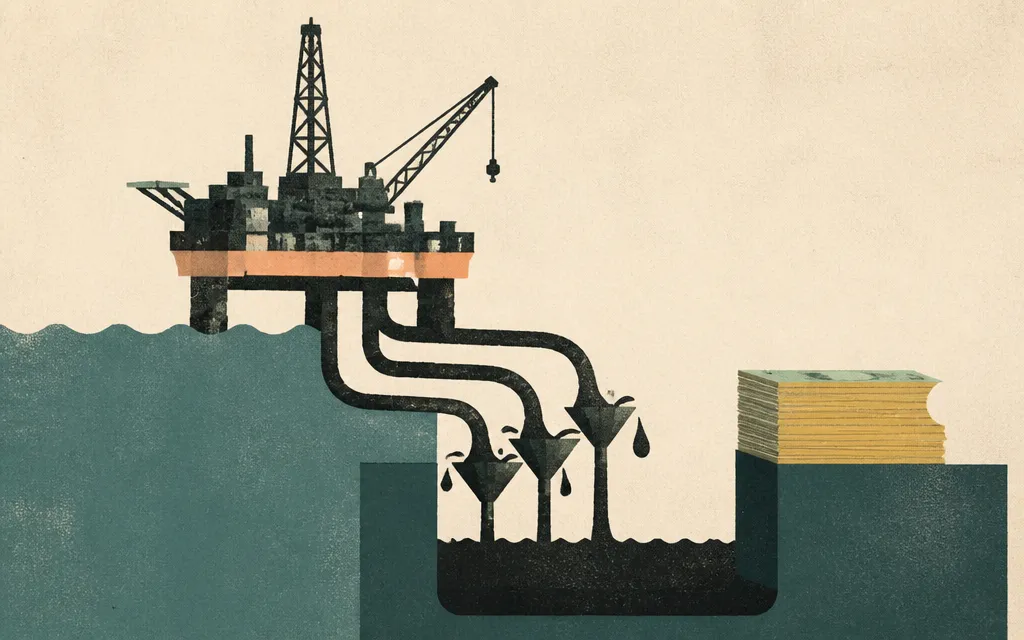
Valaris spent $206.4 million on capital projects in six months. Its operating cash flow was $88.1 million. That is the oddest number in a filing otherwise dominated by falling profit.
The latest three months ended June 30 looked straightforward at first: revenue dropped 12.4% from the comparable period, to $539.2 million, while operating income fell 68.9% to $51.1 million. Cash moved in the opposite direction, rising 7.5% to $541.2 million.
Cash on hand, though, is not the same thing as cash generated by the rigs. The company’s six-month operating cash flow fell from $275.9 million a year earlier, while capital spending rose 23.3%. Free cash flow margin declined by 20.6 percentage points to negative 11.8%.
Valaris says the cash spending went alongside upgraded rigs and assets placed in service. Its own summary puts the operating and investment flows together:
"Our net cash provided by operating activities and capital expenditures were as follows (in millions): Six Months Ended June 30, 2026 2025 Net cash provided by operating activities $ 88.1 $ 275.9 Capital expenditures $ (206.4) $ (167.4) During the six months ended June 30, 2026, we generated $88.1 million of cash flow from operating activities primarily due to operating income for the period of $71.1 million and the receipt of approximately $43.0 million of U.S. income tax refunds, which were partially offset by other changes in working capital."
10-Q, Aug. 6, 2026
The tax refund helped the six-month cash figure. It did not change the basic arithmetic: the capital program was more than twice the cash generated from operations.
The income statement has its own footnotes. Operating margin narrowed to 9.5% from 26.7%, and net income fell 56.2% to $50.4 million. Valaris also recorded a $36.6 million pre-tax gain from selling VALARIS 104, while favorable foreign-exchange movements added $10.9 million to other income compared with the prior-year period.
Some of the year-over-year comparison also reflects one-off items, including a prior-year arbitration accrual reversal and a current-year reversal of bad-debt expense after a settlement. Valaris described the combined effect this way:
"Further contributing to the offsetting increase was a net $5.4 million increase attributable to non-recurring items, comprised of a $17.1 million accrual reversal in the prior year period related to a favorable arbitration outcome for a previously disclosed patent license litigation, partially offset by an $11.7 million reversal of previously recognized bad debt expense during the current year period in connection with the execution of a favorable settlement resulting in the collection of outstanding customer invoices from 2020."
10-Q, Aug. 6, 2026
The settlement involved the collection of old customer invoices, while the asset sale contributed to other income. The reported operating comparison remains: fewer dollars came in, operating profit fell faster, and the company invested heavily in its fleet.
Valaris does not give one neat reason for the 12.4% revenue decline in the supplied discussion. It does say ARO revenue was roughly flat sequentially, with scheduled repairs and maintenance reducing operating days for some rigs and improved uptime at others offsetting part of that effect.
The balance-sheet increase leaves the central question intact. Did cash rise because the business generated more durable operating liquidity, or because refunds, settlements, and asset sales helped bridge a capital-intensive period?
Will Valaris’ next quarterly report show operating cash flow catching up with capital spending, or only another cash balance without that answer?